Cathedral of the Immaculate Conception

Springfield, IL

  • About
    • Contact Us
    • History of the Cathedral
    • Liturgical Schedules
    • Parish Staff
    • Register with Cathedral
    • Subscribe to the Cathedral eWeekly
  • Sacraments
    • Baptism
    • Becoming Catholic
    • Matrimony
    • Vocations
  • Ministry List
    • Adult Faith Formation
    • Cathedral Meal Train
    • Cathedral Online Prayer Wall
    • Cathedral Concerts
    • Family of Faith
    • Grief Share
    • Health and Wellness
    • Spiritual Resources
  • Stewardship
    • Stewardship: A Disciple’s Response
    • Stewardship Form
  • Support
    • E-Giving Frequently Asked Questions
    • Give Online
  • Sunday News
    • Announcements
    • Cathedral Weekly
    • Livestream Feed
    • Submit a Mass Intention Request
    • Weekly or Announcement Submission

The Joy of Repentance

When I was in seminary, I had a professor of the New Testament who insisted that we should rename the “Parable of the Prodigal Son.” His claim—which isn’t wrong—was that the title we’ve given to this parable seems to imply that its focus is on the younger son, who prematurely requests his inheritance, spends it on a life of profligacy, and returns in repentance to the great joy of his father (and to the vexation of his older brother). But reading the parable, it’s clear that Luke doesn’t mean for us to focus on the son so much as on the father, whose response to the waywardness and repentance of his son is categorically generous, to say the least. My professor preferred rather to call this familiar story the “Parable of the Merciful Father.”

Admittedly, what we call a parable is of significantly less importance than what we understand it to mean. But my professor was right in insisting that we must focus on Jesus’ focus.

In our Gospel this Sunday, we’re given several parables to ruminate upon—the parables of the lost sheep, the lost coin, and the prodigal son. These are parables we’ve all heard many times before. They center on the themes of “return,” of repentance, of rejoicing. But in our familiarity, we often overlook what the focus of these parables really is: not our subjective experience of conversion or repentance, but the almost foolish abandonment of God in pursuing us.

Our God is relentless! He desires us immensely. I always chuckle a bit when I read the question Jesus poses to the Pharisees and scribes: “What man among you having a hundred sheep and losing one of them would not leave the ninety-nine in the desert and go after the lost one until he finds it?” The answer, of course, is no one! No self-respecting businessman would abandon such a valuable flock—in the desert of all places!—to pursue a single errant sheep. But our God does. Why? Because He’s the lover of His creation. He knows us intimately, and even in our sinfulness (or whatever ways we find ourselves to be undesirable), He pursues us. And when we finally make that return to Him from wherever we’ve been, however we’ve strayed, He rejoices, because we are of greatest value to Him.

These parables highlight something intensely true about conversion: the emphasis is far less upon us than it is upon our relentless God. If we remove the obstacles we have to conversion, God’s grace cannot help but prevail in our lives. That’s exactly what the Sacrament of Confession is about. It’s about identifying those roadblocks to grace and allowing God to restore us. And we can be assured of this: when we allow Him to pursue us, to manifest His power in our lives, to call us back to Himself, “there will be joy in heaven.”

Do yourself a favor and let yourself be found. Like the prodigal son, bring yourself to the confessional—to the throne of God’s mercy—and experience the joy God has when we return to Him. Don’t worry or fret, because the work of conversion really belongs to God. For our part, we just have to want to be found.

Fr. Michael Friedel is a Parochial Vicar for the Cathedral of the Immaculate Conception and the Chaplain of Sacred Heart Griffin.

What’s this thing about Confirmation moving to third grade?

Your questions, answered.

Candidly, as a father of five not-yet-confirmed children, when I first heard of the concept of “restored order of the sacraments of initiation,” I thought it was a terrible idea to lower the age of confirmation to third grade. As I listened and learned, however, I found myself saying to Bishop Thomas John Paprocki, “Please confirm my children as soon as possible!”

I know many parents and grandparents have the same initial reaction to restored order, so I want to share what changed my mind. Here are answers to the common questions I originally had and what friends ask me today. I hope you find this helpful.

Why would we start confirming children at a younger age?

First, it’s important to note that we are not starting something new. Aside from fairly recent history, it has always been the church’s practice to first confirm new members and then welcome them to receive Communion. This practice held for adults and children, alike, and it has continued to the practice of RCIA. In fact, the Catechism of the Catholic Church clearly affirms the proper sequence in paragraph 1322: “The holy Eucharist completes Christian initiation.”

The current approach of inverting the sequence of first Eucharist and confirmation first appeared in France in the middle of the 19th century, as the bishops sought a longer formation period for confirmandi. In 1879, Pope Leo XIII rebuked the French practice and ordered the original sequence to be restored, but the bishops failed to make the change. The practice spread subsequently to the American church as well.

So, the real question is not why we would lower the age of confirmation, but rather what have we gained by deferring it to a later age? The facts in this regard are eye-opening. Consider that nearly 80 percent of all fallen away Catholics were never confirmed, and the average age of Catholics falling away from the faith is 13 years old. By deferring the age of confirmation, we have deprived these children of the gifts of the Holy Spirit, which are strengthened by the sacrament of confirmation. We will never know what might have otherwise happened for them.

OK, but why now? How is this going to help our children?

Bishop Paprocki summed it up best, saying: “Given what our children are confronting in society, why would we delay the grace of confirmation — a grace that can protect them from those dangers.”

Our children are facing an unprecedented barrage of threats to their emotional well-being and moral clarity. With the invasiveness of technology and social media, nearly half of all children report being victims of cyberbullying. More than 70 percent have witnessed cyberbullying and are concerned about it, and victims of cyberbullying are as much as nine times more likely to commit suicide. Girls are twice as likely to be victimized by cyberbullying than boys. Meanwhile, 97 percent of boys have viewed pornography, nearly one quarter have tried to stop but can’t, and 13 percent report watching increasingly graphic and violent pornography.

Deferring confirmation deprives our children of special graces that can help them withstand the spiritual challenges of this new reality. Further, deferring confirmation until they are already swimming in these waters also increases the likelihood that they will experience barriers to the sacramental grace. After all, as St. Thomas Aquinas teaches us, there are three obstacles to grace: lack of faith/insincerity; lack of repentance; and presence of demons. (STL III 66-68) Therefore, delaying confirmation is a double-edged sword: It deprives our children of grace they badly need at a younger age; and it likely decreases the effectiveness of the sacrament in their lives.

Won’t students leave our schools/programs after third grade?

As a point of fact, enrollment in Catholic schools in the Archdiocese of Denver has increased since the implementation of restored order there. This doesn’t mean that restored order caused the increase, but it certainly shows that students didn’t flee the system after third grade. Further, our PSR programs provide sound preparation for the sacraments of initiation. So, there is already a free alternative to Catholic schools. Therefore, sacramental preparation cannot be the only reason parents invest in Catholic education for their children. To be clear, we have much work to do to ensure our schools remain affordable and compelling for students and parents, especially in the formation of the whole person as a disciple of Christ. Sacramental preparation is an important part, but only a part, of this mission.

How can we expect third-graders to be prepared to confirm their own faith as adults in the church?

This question points to a couple common points of misunderstanding regarding the sacrament of confirmation. The first over-emphasizes the action of the confirmand in the sacrament, and the second mistakenly views confirmation as a sort of graduation from faith formation. Paragraph 1308 of the Catechism states: “Although Confirmation is sometimes called the ‘sacrament of Christian maturity,’ we must not confuse adult faith with the age of natural growth, nor forget that the baptismal grace is grace of free, unmerited election and does not need ‘ratification’ to become effective.”

It is certainly important that recipients of the sacraments be properly disposed and prepared to receive the sacraments. As noted above, however, there is a very high probability that a thirdgrader is more open, receptive, and properly disposed to this sacramental grace than an eighth-grader. Conversely, it is more likely that an eighth-grader faces greater obstacles to grace. The church has deemed the age of reason to be the age of 7.

But confirmation and Eucharist in the same year? Isn’t this a lot for children to grasp?

If an 8-year-old is able to understand enough about the Eucharist — that the bread and wine are changed with the words of consecration and become the very Body, Blood, Soul, and Divinity of Christ —and be properly disposed to receive the Eucharist reverently, then it seems reasonable that he or she is also able to understand what it means when we teach that the Holy Spirit gives seven gifts to be used in faith. In fact, this is why the church established the “age of reason” as the appropriate normal age for reception of the sacraments of initiation.

Quoting St. Thomas Aquinas, the Catechism of the Catholic Church wisely reminds us that “age of body does not determine age of soul. Even in childhood, man can attain spiritual maturity: as the book of Wisdom says: ‘For old age is not honored for length of time or measured by number of years’ (4:8). Many children, through the strength of the Holy Spirit they have received, have bravely fought for Christ even to the shedding of their blood” (CCC, 1308).

Will the diocese be offering a curriculum or any kind of lesson planning resources for teachers?

Yes, the diocese is offering resources. Most of the publishers the parishes use already offer curriculum for restored order, since it is becoming increasingly common across the country.

Is this change being made in other dioceses?

This change has been encouraged by both Pope Benedict XVI and by Pope Francis, and many bishops are implementing or planning for the restored order. In the United States, about 15 dioceses to date have implemented the restored order, including Phoenix, Denver and Spokane. Earlier this year, the Denver Archdiocese reported: “The Archdiocese of Denver, as it nears the completion of its transition to Restored Order Confirmation, has seen a number of fruits: greater parent participation in religious education, a new curriculum and parent resources, and a more dynamic approach to catechesis.”

Isn’t this a lot for our teachers?

It is certainly a significant change for our teachers, but our schools are blessed with gifted and talented teachers who are eager to do what is best for their students. Each parish has the flexibility to choose the curriculum and transition approach they feel is best for their teachers and students. So, as your school implements restored order, please be patient. Let’s remember that we should treat this as an opportunity to form lifelong disciples of Christ.

How is this going to work in my school?

Since each parish has flexibility to manage the transition in the way they see fit over the next few years, you should ask your pastor or principal for the plan at your parish or school. Some are taking a slower approach, phasing the change in over time, while others have already completed the transition by confirming children in grades 3-8 in a single year.

Final thought …

Let’s allow the Holy Spirit to do what he does best — inspire, teach, and guide us. I’m confident, if we put our trust in God and faith in the sacraments, restoring the sacraments to their proper sequence will be of great benefit, especially our young people.

Mike Christie is the Diocesan Director of Evangelical Diocesan Director of Evangelical and Catechetical Services and a Parishioner at Blessed Sacrament Parish, Springfield.

Becoming Catholic

Are you looking to grow deeper in your relationship with Jesus? Are you discerning Catholicism? Have you attended Mass at Cathedral or a faith formation program and are curious about joining our faith community? The Rite of Christian Initiation of Adults (RCIA) is the opportunity for adults to explore their relationship with Jesus and learn about the Catholic faith.

RCIA is a journey geared toward those who:

  • are not baptized,
  • or are baptized in another religion,
  • or are baptized Catholics but have not been fully initiated (received First Eucharist)

A Safe Place to Ask Questions

The process is flexible and depends on the individual’s faith journey. You will be provided an opportunity to learn how Catholics express their faith and their relationship with Jesus through liturgical life, the sacraments, and parish life. By the power of the Holy Spirit and through prayer, each participant will be able to discover the meaning of discipleship in the Catholic Church and then ultimately make the decision on whether to join the Catholic Church more formally.

The process is open to all searchers and seekers, whether you once were Catholic and have not completed the sacraments of initiation or if you were raised within a different faith community or none at all. Just because you start the RCIA process, doesn’t always mean you complete it. If you are curious, we will walk with you the whole way to provide you with the information you need.

All are welcome to join us!

The process begins with an inquiry form, found at https://spicathedral.org/ becoming-catholic/.

You will then meet with staff member, Vicki Compton, to familiarize yourself with the process here at Cathedral and provide us with the opportunity to get to know a little more about you.

If you have any questions, please contact Vicki Compton at 217-522-3342 ext. 146 or email at [email protected]

What Is a Disciple?

The word disciple is often replaced with student but it is not the same thing. To be a disciple, in the context of ancient Israel meant more than just studying a subject or sitting through a class. To be a disciple of a great teacher was more like being an apprentice learning from a master. The disciple would devote himself to the teacher, seeking to become like him.

Who Could Be a Disciple?

After years of studying and memorizing Scripture the best and brightest might go and seek out a rabbi. The rabbi would examine the student’s knowledge and understanding of Scripture, trying to discern if the student had what it took to follow him. When a rabbi accepted a student as a disciple what he was saying was “Yes, I think you can be like me.”

A Disciple of Jesus?

Jesus turned that all on its head. Unlike other teachers, Jesus did not look for the most learned. He did not pick the most likely. He did not pick the best and the brightest. Instead Jesus collected a random assortment of misfits. Take a quick look at the apostles.

John and Andrew appear to fit the classic model. They were followers of John the Baptist, they sought out Jesus and asked to follow. After them, however, Jesus departs from the norm almost immediately. He calls Andrew’s brash fisherman brother, Peter. Peter was fishing, not looking for a rabbi. Jesus then goes and sort of starts just collecting people. Phillip is presented as just being there. Jesus even picks up a tax collector, Matthew. Now, tax collectors have never been liked all that much, but for a Jew to be a Roman tax collector, well, the Roman emperor claimed that he was a god so it was essentially as if the Matthew was serving another god. Good Jews would have gone out of their way to avoid Matthew.

Jesus took a bunch of misfits, looked them straight in the eye and said, “Yeah, I think you can be like me.”

What Did Jesus Ask of His Disciples?

The disciples of Jesus gave up everything to follow him. Peter just walked away from his fishing boat. John and Andrew left John the Baptist. Matthew left his lucrative tax collection business. Jesus lays out what it means to follow him pretty clearly in Matthew 16:24: “Then Jesus said to his disciples, ‘Whoever wishes to come after me must deny himself, take up his cross, and follow me.’”

To “deny” someone at the time of Christ was more like disowning them. When Jesus tells his followers to deny themselves he is saying, “You can’t be the center of your universe anymore.” Remember, Jesus’ cross was not just about suffering. It was about us. Jesus carried the cross for our freedom. In Matthew 16:24 Jesus is telling his followers, “your life has got to be about something greater than you. It is about bringing people to me. The way you do that is by offering yourself. That is how you become like me.”

Are You Ready to Follow?

Jesus is still calling unlikely disciples. He is calling you. Right now Jesus is looking you in the eye saying, “yeah, I think you can be like me.”

It might sound like you will never be able to live up to that call, but remember, Jesus did not call the best and the brightest. He did not call the most qualified. He called the willing. He did not expect us to do it alone. He did something incredible. He sent the Holy Spirit so that you and I could learn from him personally, so that we could become like him.

You can start being his disciple by reading through the Gospels. Immerse yourself in his life and teaching. Ask the Holy Spirit to counsel you and to help you be like Jesus. Ask him to help you start living a life that is offered for the sake of others. You might notice things that are keeping you from following him; old habits or sins. Drop them like Peter dropped fishing. Confession is a good place to do that. God will help you get out of the center of the universe, so that he can take his proper place.

The last thing to remember is that disciples did not become like their master in an instant. They walked with him for years, each day becoming a little more like the one they followed. If you have not already, today you can become his disciple.

This article was first published on Steubenville Fuel (https://steubenvillefuel.com/2015/10/12/what-is-a-disciple/).

Chris Mueller is a youth minister from Murrieta, California. Chris is the president and founder of 242Revolution Ministries. Chris and his wife, Christina, live in California with their five children.

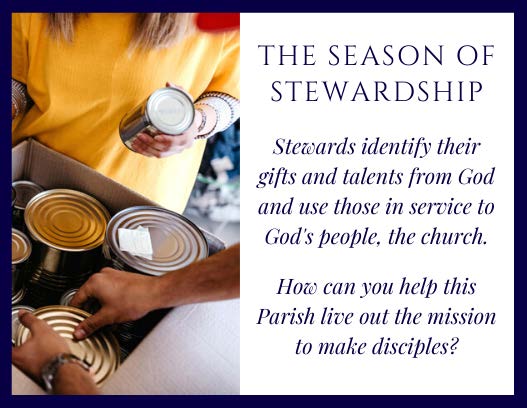
Activating a Stewardship Way of Life

In preparation for the Season of Stewardship this fall, let’s reflect on stewardship as a way of life. The four pillars: Prayer, Formation, Hospitality, and Service create the framework and model for our Parish mission. This week we are looking at formation. What are you yearning to learn about your faith? Are you able or willing to share your faith with other?

Opportunities for Stewardship: Formation at Cathedral

Adult Faith Formation Series

View our calendar of topics here:

https://spicathedral.org/adult-faith-formation-2/

Family of Faith

All are welcome to the teach sessions and the calendar can be found here: https://spicathedral.org/family-of-faith/

Simple Wisdom

Our Lord offers us what might be termed “simple wisdom” in this Sunday’s Gospel, but wisdom that will nonetheless bear fruit unto eternal life. Jesus is attending a dinner at the house of a leading Pharisee and Luke tells us that everyone is watching Jesus and he is watching everyone else as well. He then turns events of the occasion into a parable.

Jesus is observing the guests as they choose where they are going to sit for the dinner. Both honor and shame were significant parts of life in Jesus’s day, Jewish culture being no exception. On observing his fellow guests, Jesus offers an admonition that it is better to be moved up than to be moved down, the former bestowing honor, the later bestowing shame. Jesus teaches that it is better (and safer) to always seek the lower position. While this may seem to be savvy social etiquette, it also has meaning for our discipleship.

Luke juxtaposes the lowly and the lofty in another place in his Gospel, early on when he records for us Mary’s prayer of praise when she visits her cousin Elizabeth. We call this prayer the “Canticle of Mary” or the Magnificat. In that prayer, recounting the goodness of God, Mary offers praise to the Lord because he “has cast down the mighty from their thrones and has lifted up the lowly.” The Christian life reminds us that seeking high places can result in us holding a very tenuous position. However, if it is God who is doing the lifting then who can bring us back down? Just as with places at table, it is far better to be moved-up than to be knocked-down.

And regarding those who are invited to table, Jesus turns social convention on its head a second time. Jesus tells us that in seeking others to share your hospitality with, do not look for those who can offer you anything in return. This is counter to a society, then and now, that is quid pro quo or “this for that.” In offering hospitality, care, or concern to those who can offer nothing in return, the world cannot second guess our sincerity; however, when we open our lives in generosity for the sake of generosity, do not think that there will not be a return on the gift. The return will be made by God, both with grace in this earthly life and the promise of a greater life in the Kingdom of Heaven.

Father Christopher House is the Rector of the Cathedral and serves in various leadership roles within the diocesan curia, namely Chancellor and Vicar Judicial.

Turning to Mary in Difficult Times

I never fully understood Mary when I wasgrowing up. As a cradle Catholic, I memorized the “Hail Mary” by the age of 6, and knew that she was a special woman chosen to be the Mother of God. She was blessed and courageous. My pastor told me Mary was most likely only a teenager when she was visited by the Angel Gabriel and presented with God’s plan for her. I marveled at her ability to say “yes” to God while still so young. I wanted to be like her but didn’t see much connection between us.

Years later, tragedy struck my dear friend, Clara. Her daughter arrived stillborn, and it seemed like even Jesus couldn’t ease her pain. I accompanied Clara to a counseling session at her church. The charming French spiritual director offered this piece of advice: “The Virgin will comfort you, madame. She, too, lost a child.” He lovingly handed Clara a statue of the Holy Mother, but it felt like little comfort for her pain. Clara wanted her baby healthy and whole, not a fragile statue of the Virgin Mary, which fell to the floor and shattered as she wept.

Whenever someone’s going through a difficult time, there’s a generic, almost scripted response that Christian’s typically give: “God knows what you’re going through.” Those words didn’t provide me much solace when I was plagued with an undiagnosable virus this past winter. My body became foreign to me as I hunched over a bucket for weeks on end, unable to eat or keep anything down. I know God didn’t abandon me during this time, but it was difficult to feel his love when there was seemingly no end in sight. I asked some friends to pray for me, and their response was that God could relate to what I was going through because he actually lived it.

I believe that Jesus was subject to every human suffering and temptation. Jesus was made of flesh like me and knows nearly every pain I could ever go through. Nearly every pain. God’s human experience was that of a man, not a woman. Now, I know that God isn’t limited by gender, and my incomprehensible, allknowing God still understands my pain as a woman. But that’s not the same as having lived it.

God didn’t inhabit a woman’s body, but there’s someone we can turn to when we’re suffering who did. That someone is Mary. She’s a comforter I can rely on when I’m facing a health issue unique to my female body or when I’m struggling with my relationship with my family. She models obedience, strength, gentleness, and solidarity. She also understands the grief of a mother in mourning, having lost her own son.

After more time and reflection, I can see the wisdom in the spiritual director’s words to my friend. Clara’s tragedy actually taught me to turn to Mary, talk to her, and ask her to pray for me. I tried this when I was ill, knowing that Mary could not only offer me the love of a mother for her child, but she could also see me through my pain. Her love could help me get through my health challenges.

Mary understands me in ways that only a woman can. I often question my place in society, the Church, and God’s family. I wonder how I can serve God as a woman who isn’t called to religious life. Mary assures me of my own worth in the Kingdom. Mary’s example of accompanying Jesus through his suffering on the Cross inspires me to support my own friends and family with the same compassionate presence. She stayed by Jesus’ side and never left. I can only hope to be there for my dear ones in the same way.

By the grace of God, Clara gave birth to a rainbow baby and named her Faith.

Faith is what I strive for. I want to have faith like Mary, to follow her example, and to talk and pray with her more. In the end, I’ve learned that it’s not so important for me to understand Mary. What really matters is that she understands me.

Jessica Santulli has written articles for various Christian websites. She holds a bachelor’s degree in writing and works for a reference publisher in Northern New Jersey. In her free time she enjoys photographing nature, running, swimming, and leading a young adult Bible study.

The Power of a Parent’s Prayer

This Tuesday, August 27th, is the liturgical remembrance of St. Monica, the mother of St. Augustine. If you have a chance to visit Rome, go to the Church of St. Augustine off of the Piazza Navona and there you will find her tomb, where her relics were brought to Rome in the fifteenth century.

St. Monica was born in modern day Algeria in the fourth century. Her life was marked with both tears and faith-filled devotion. Monica, a devout Christian, married a pagan named Patricius who was known for his fierce temper, which he apparently got from his mother who lived with the couple after their marriage. Tradition tells us that the tempers of both Patricius and his mother constantly flared at each other, robbing St. Monica of much peace. The couple had three children, two boys and a girl, Augustine being the eldest.

Patricius died when Augustine was seventeen, both Patricius and his mother having been successfully converted to Christianity by St. Monica one year earlier. Monica’s tears, however, were not at an end. Augustine was sent to school in Carthage after his father’s death. Still having never been baptized because of his father’s earlier refusal, Augustine fell into the false religion of Manicheanism while there.

From the time Augustine arrived in Carthage, his life continued on a trajectory contrary to the Christian life. At Monica’s behest, Augustine ended a fifteen-year affair that he had with a woman, which produced a son, Adeodatus. Augustine agreed to an arranged marriage that was to take place in two years’ time, but the Lord had something else mind. The following year, at the age of 31, after years of prayers and tears on the part of Monica, Augustine was converted to the faith by the grace of God and the spiritual care of St. Ambrose, bishop of Milan. Later, Augustine would eventually be ordained a priest and bishop.

Following his baptism, Monica and Augustine believe that the Lord was calling them to spread the faith in Africa, but six months later, as the pair were making their way to the continent, Monica died just outside of Rome. In his great autobiographical work Confessions, Augustine recounted one of their final conversations as his mother was dying. Monica said: Son, as far as I am concerned, nothing in this life now gives me any pleasure. I do not know why I am still here, since I have no further hopes in the world. I did have one reason for wanting to live a little longer: to see you become a Catholic Christian before I died. God has lavished his gifts on me in that respect, for I know that you have even renounced earthly happiness to be his servant. So what am I doing here?

By all accounts, Augustine had lived a life void of God for much of his younger years, but Monica never gave up hope in the Lord’s power to save. At a time of the Lord’s choosing, the hardness of Augustine’s heart was broken and he would eventually become one of the greatest theologians and saints in the Church’s history. I offer this short sketch of Monica’s life with her son Augustine especially for those parents who are grieved by their children’s lack of practice of, or departure from, the faith. Many times through the years I have been asked by parents in this situation what they should do and my response has always been based on St. Monica’s actions: love them, pray for them, and continue to be an example of faith for them.
This Tuesday evening, August 27th, as the Church celebrates the memory of St. Monica, we will offer a special holy hour in the Cathedral at 7PM for children, and for their parents, who have fallen away from the practice of the faith. As we will be spending this time in prayer before the Lord in adoration of the Blessed Sacrament, I have no doubt that St. Monica, St. Augustine, our Blessed Mother, St. Joseph, and all the Saints will be offering their prayers as well from their places in heaven for these special intentions.

In remembering St. Monica the Church prays: O God, who console the sorrowful and who mercifully accepted the motherly tears of Saint Monica for the conversion of her son Augustine, grant us, through the intercession of them both, that we may bitterly regret our sins and find the grace of your pardon. Through Christ our Lord. Amen.

Father Christopher House is the Rector of the Cathedral and serves in various leadership roles within the diocesan curia, namely Chancellor and Vicar Judicial.

Love Is Easy Until It’s Tested

“Father, forgive them, they know not what they do” (Luke 22:34).

The love of God wasn’t proven when God created the world in Genesis 1. That happened about a thousand chapters later. “He proved his love by dying for us.” (See Romans 5:8).

The same is true for us. Love is easy until it’s tested. When it requires sacrifice, it’s proven.

It’s easy to love people until we meet…those people. It’s easy to love our enemies until we actually have enemies. Heck, it’s easy to be a parent until we have kids!

Authentic love demands that we speak the truth even at the risk of being crucified for it, because love doesn’t stand by silently as people fall into the darkness of sin. It calls us to open our hearts to those who disagree with how we see the world, even at the risk of being hurt by them. Love pushes us out of our comfort zones into places we’d rather not go to serve the poor. Love demands that we stop asking “how can my wife/parent/sibling be better” and start asking “how can I make my wife/parent/sibling the happiest in the world? Love demands death to self.

It’s enjoyable to love when it’s easy! Jesus said it himself. “If you love those who love you, what reward will you get? Are not even the tax collectors and sinners doing that?” Think about it: even Hitler was probably all smiles when he was playing golf with his closest friends! But God “causes his sun to rise on the evil and the good, and sends rain on the righteous and the unrighteous.” Every. Single. Day. That’s how we’re called to love. The early Christians didn’t convert the world by words alone, but by their love in the face of pain.

The early Christians had it far worse than us. On any given Sunday one could go to the Roman Coliseum and see fellow believers being eaten by lions to the loud cheers of their neighbors. Worship and catechesis took place in secret.

They had good reasons to be angry! Very angry. They had every right to flee the world. But they didn’t. They spoke truth to power. They fought for their rightful place in society. They spoke out. St. Paul was as crafty as a lawyer when he was on trial. Christians engaged all levels of society from standing up for the dignity of the poor to St. Sebastian’s legendary face-to-face confrontation with the emperor, for which he was pierced with arrows. They didn’t budge an inch when it came to the evils of their day. Countless Christians faced death rather then offering a single pinch of incense as worship to the emperor.

But more than resisting the powers that be, they resisted the enemy within. They resisted the natural tendency to categorize the world as “us” verses “them.” For the saints, the only “us” was humankind, the only “them” was the devil and his legions. They weren’t like other prisoners when they were executed. They didn’t curse at those who tortured them. They forgave. The early Christians were able to engage the world as much with their love as with the truth. That’s why Christendom was born within 300 years of Christ’s death.

If they hadn’t followed the example of Jesus, who could dine with sinners and forgive his murderers, Christianity would’ve ended in the Coliseum as soon as the last Catholic was eaten for lunch.

“I say to you, love your enemies.”

Spend a minute reflecting on who it’s most difficult for you to love, and make a choice to do something concrete and generous for that person. And if it’s someone you can’t be in contact with for some reason, try a simple prayer, even if it’s through gritting teeth, “Lord Jesus, I ask you to bless (insert the person who hurt you most) in every way! Most of all with saving grace and the discovery of YOU.” Pray that daily until you mean it.

If you love like that, not only will you change the world, you’ll change.

Archbishop Charles Chaput has called Chris Stefanick “one of the most engaging young defenders of the Christian faith on the scene today.” Chris speaks to over 50,000 teens, young adults, and parents every year. His website can be found at RealLifeCatholic.com. Chris Stefanick will be presenting REBOOT at the Cathedral on Sept. 19th at 7PM. All are welcome! Grab your tickets ($25) today! Each tickets includes a night of transformation with Chris, books, resources, and so much more! This blog piece originally appeared here: http://www.ncregister.com/blog/cstefanick/love-is-easy-until-its-tested

Family Faith Formation

A Catechist Perspective

What does God look like? Why do we have to go to Mass? Why can’t I watch that movie? As a parent and PSR teacher, I have at times been stumped by questions kids have asked about God and our faith. Children come up with really interesting and important questions that provide great insights into their spiritual lives and deserve thoughtful and meaningful answers. The adults who know the children best — parents, grandparents, other family members, and close family friends — are in the best position to address their questions in a way that will increase their love and understanding of God. In company with other families, Family Faith Formation will help you build the tools and knowledge to deal with those challenging questions and will be a wonderful opportunity to learn how to encourage your children’s questions and help them (and you) grow spiritually.

Jane Fornoff
Cathedral parishioner, catechist, choir member and Alpha leader

 Ready to Sign-up?

To sign-up, please go to the website at https://spicathedral.org/ family-of-faith/ .You will also find more information and the calendar available on that page.

Teaching Meetings

All adults of the parish are invited to attend the monthly teaching sessions, but special invitation is extended to parents, grandparents, aunts, uncles, guardians, young couples preparing for marriage – anyone who has or will have responsibility for passing on the faith to children.

September 8
The Role of Parents in Faith Formation, 6:15-7:30 PM

October 6
What is Faith? Who is God? 6:15-7:30 PM

November 3
Created in God’s Image, 6:15-7:30 PM

December 1
Annunciation, Immaculate Conception, 6:15-7:00 PM

January 12
Who Is Jesus, 6:15-7:30 PM

February 9
Paschal Mystery, 6:15-7:30 PM

March 8
The Holy Spirit, 6:15-7:30 PM

April 5
Marks of the Church, Communion of Saints, 6:15-7:30 PM

May 3
The Way of the Creed, 6:15-7:30 PM

 Additional Questions

If you have questions, please contact Daphne Southern at [email protected] or 638-2805.

Road Trips and the Journey of the Mass

I have loved being on the road ever since I was young. Each summer my scout troop—Troop 110 from Barberton, Ohio —put on summer camps for us around Ohio, West Virginia, and Pennsylvania. These camps always meant the chance of going on a road trip. There was something exciting, refreshing about going to the store and buying snacks which we usually weren’t allowed to buy, getting into the car, and heading off to a new, somewhat unknown destination. Certainly, the ending location was the reason for the trip, but the journey it took to get there, for me, was always one of the most enjoyable parts of camp. I know that not everyone loves going on road trips, and the reasons people have for their displeasure with them can be understandable. Yet, why for some people is being crammed together in a car on the road for multiple hours so enjoyable? Having the right perspective can help for the greater appreciation and enjoyment of a good road trip.

For a majority of the year, most of us operate within the same fifteen-to-twenty mile circles. We drive the same roads, see the same signs and billboards, visit the same stores and coffee shops, run or cycle by the same houses on the same routes, and encounter, generally, the same people on a daily or weekly basis. Eventually, this ocular routine can become less and less stimulating and even uninteresting, which can translate to a numbing of our normally excited and inspirational selves. Going on road trip takes us outside the circle and breaks away from what has become normal, even uninterestingly so. We see different things—roads, trees, signs, buildings, and cities. We breathe different air, walk into different coffee shops and stores, and encounter new people we know are operating within their own twenty-mile circles.

There is a freshness in being in a new place, and this freshness can transport us to a different mental place as well. When we are in a new place we can begin to think new thoughts. We can set aside struggles and challenges we have with certain people and situations as we experience reality in a renewed way.

The Church’s Eucharistic liturgy, especially when it is done well, takes us outside of what is normal; it takes us to a realm beyond our earthly, temporal space. In the liturgy, we see different things, smell different things, hear different things than we would on a normal morning. Going to Mass on Sunday breaks us outside of our normal daily routine and for a good reason. It is a reminder that encountering God is an encounter with the Being who is mystical and otherworldly, yet can be found in our everyday experience.

In The Wellspring of Worship, a masterpiece on the cosmic depth of the liturgy, Jean Corbon states, “The church of stone or wood that we enter in order to share in the eternal liturgy is indeed a space within our world; it is set apart, however, because it is a space that the Resurrection has burst open.” Our churches are designed in a specific, intentional, beautiful, and incarnational way to help our minds and hearts journey to God. For this reason, the church building, the place of encounter with God, should look drastically different than its surroundings, inside and out. These places should help transport us—mentally and spiritually, body and soul—to an otherly place, a place outside of space and time, yet one within our own world.

Just as driving in the car down the road for hours can be grueling to some and transforming for others, liturgy can be transforming for some and grueling for others. Some of the reasons people have for not liking the work of liturgy are even understandable… but only if they misunderstand the purpose of the liturgy and struggle to truly enter into the ritual.

If we really allow ourselves to enter into a road trip—the newness of the sights, the smell of the fresh air, the conversation with friends—it can be an enjoyable experience. After a great road trip we can come back to our lives with a fresh energy and perspective, maybe seeing our normal routine in a new way.

Similarly, entering more deeply into the Mass can change our experience of the Mass completely. Instead of a weekly spiritual chore, entering into the Eucharistic liturgy can be a refreshing part of our day or week, a brief spiritual road trip where we are transported body and soul, but only if we have such an approach. By having the right perspective and appreciation of what liturgy is and can do in our lives, the liturgy becomes not a task to be done, an appointment to be checked off, but a rejuvenating spiritual journey. The destination then lies in taking the fruit of that journey back out into our normal, often routined, everyday life.

Deacon David Stavarz is a transitional deacon for the Diocese of Cleveland. He is a graduate of Borromeo College Seminary and is currently finishing his formation at St. Mary Graduate Seminary, in Cleveland, Ohio. Dc. David hopes to be a priest of the diocese in May of 2019. This article originally appeared here: https://www.wordonfire.org/resources/blog/road-trips-and-thejourney- of-the-mass/5819/

« Previous Page
Next Page »

Liturgy

Sunday Masses (unless noted differently in weekly bulletin)
Saturday Evening Vigil – 4:00PM
Sunday – 7:00AM, 10:00AM and 5:00PM

Weekday Masses (unless noted differently in weekly bulletin)
Monday thru Friday – 7:00AM and 5:15PM
Saturday – 8:00AM

Reconciliation (Confessions)
Monday thru Friday – 4:15PM to 5:00PM
Saturday – 9:00AM to 10:00AM and 2:30PM to 3:30PM
Sunday – 4:00PM to 4:45PM

Adoration
Tuesdays and Thursdays – 4:00PM to 5:00PM


CatholicMassTime.org

Parish Information

Parish Address
524 East Lawrence Avenue
Springfield, Illinois 62703

Parish Office Hours
Monday thru Thursday – 8:00AM to 4:00PM
Fridays – CLOSED

Parish Phone
(217) 522-3342

Parish Fax
(217) 210-0136

Parish Staff

Contact Us

Contact Us

Copyright © 2025 · Log in