 In our efforts to evangelize and proclaim the Gospel, it is good to keep our focus and prayer on the goal of our work—that others will come to faith in Christ and enjoy a personal relationship with him. This intrinsic connection between faith born from evangelization begins with Jesus himself in Mark’s Gospel where his first words are: “The time has come and the kingdom of God is at hand. Repent and believe the Good News!” (1:15). For St. John in his Gospel, his entire life of preaching and writing about Christ has been at the service of faith in him: “These things have been written so that you may believe that Jesus is the Christ, the Son of God and that through your faith in him you may have life” (20:30). So what then does this faith look like? What kind of faith do we hope to be born from our efforts to evangelize?
A Faith Born from Above.

In the fourth Gospel, Jesus reminds us that “no one can come to me unless the Father draws them” (John 6:44). Faith then is a gift from God born of hearing his Word and seeing it in action (cf. Rom. 10:17). Faith is not our own opinion or achievement. We cannot come to it by our own efforts. Faith does not arrive to us through one single argument or even a series of converging signs. Even when these signs are in place, it takes the gift of the Holy Spirit for us to finally “get it” and to assent to faith with our whole being. This is because the love of God engages the entire human being with all of his or her physical, psychological, and spiritual powers. This is what happened in the case of Lee Strobel as he tells his story in The Case for Christ in the movie based on the book of the same name. He set out to debunk his wife’s faith and gathered all the evidence he could find to prove his case. But while the evidence moved him in the direction of faith, it was the love of his wife and her prayers that finally clinched his assent.
A Faith that Grows. We often think of faith as something we have or we don’t have. I believe or I don’t believe and those are the only two possibilities. We also can think of faith as something that remains static and doesn’t grow. The truth is that faith can be born or reborn in us at any time, just like it was in the people who encountered Christ in the Gospels. For those who believe, there is an organic quality to faith that we recognize over time. Faith lives and grows. In the Gospels, Jesus often likens the gift of faith to a mustard seed (cf. Matt. 17:20). It begins small but can grow to such a degree that others benefit from it, like birds in the branches of a tree that began its life as a seed. Our faith in Christ is something alive and active. It prompts us to think in new ways, to act differently, and to understand God in bigger terms, beyond the image of him we already have. Faith also takes us beyond our comfort zones, moves us closer to those on the margins, and grounds our faith in the service of truth and charity.
This demands a necessary openness on our part to allow our faith to grow, to be affirmed and to be challenged when necessary. So when it comes to the big questions of our time, we should not be afraid to engage our faith with the confidence that the Holy Spirit gives us. The Gospel message entrusted to us bears within itself the truth that sets humanity free and sets us on course for a better life.
While this task of engaging with the big questions of the world can be difficult and even dangerous, it affords us the opportunity for our faith to be tested and to grow. It is like a muscle of our bodies that grows stronger when it is used and made to work. So far from being something static, our faith is something that progressively changes us to become more Christ-like and sends us on mission in his name. There is a dynamism in faith that invites us to a meta-noia or “going beyond the mind we have.” It opens us to new horizons and to see all things with new eyes.
A Faith that Draws Us into Relationship.
Faith is often exclusively associated with religion. So we might hear someone say: “Yes, I have faith, I believe in God”; or, “No, I don’t have faith, I am an atheist.” This is inaccurate because it assumes that only religious people have faith while nonreligious people don’t. The truth is that faith is much more part of everyday life than we realize. As Bishop Barron has often pointed out, if a young man is in a relationship with a girl, he can collect all the data he wants about her, but until she speaks to him, the relationship can never get off the ground. Only when the two parties speak to one another can the trust begin to grow. And if the relationship grows to the point of them wanting to marry, then their decision is still based on faith and trust. By getting married, both put their faith in one another and nourish that trust afterwards as husband and wife.
So it is with God. God has spoken first through his creation and through the history of a people he loved. In the words of St. John: “God loved us first” (1 John 4:19). As Christians we see this love offered to us through the person of Jesus Christ who came to reveal God to us. Faith then is our “Yes” that accepts the truth of what God has spoken and the love for us that he has revealed. Faith is a “Yes” to a “Yes.” It is our “Yes” to God’s “Yes” that comes first. This is the basis of a relationship that unites us to God.
A Faith in Christ Jesus Our Lord.
Throughout the Gospels, Jesus reveals a God who desires a personal relationship with each of us. Through faith and trust we are invited to know him and be known by him, to be loved by him and to love him in return.
Throughout the Gospels, Jesus invites us to faith in him: “Do not let your hearts be troubled. Trust in God still and trust in me” (John 14:1); “I am the resurrection and the life. The one who believes in me will never die” (John 11:25-26). What an extraordinary claim for anyone to make! There are only two possible responses to this invitation to faith by Jesus. One is to reject him out of hand as a narcissistic madman, and the other is to do exactly what he asks us to do and come to believe in him and who he claims to be. There is no middle ground.
The more we contemplate the life of Christ—his goodness, truth, and beauty—the easier it is to believe in him. First, his goodness —his mercy, his compassion, his patience, his understanding, and his love. He spent his whole life doing good for everyone, and his love gave birth to faith in him. His truth—before Pilate he said that he had come for this, was born for this, to bear witness to the truth, and all who are on the side of truth listen to his voice. Without truth, humanity caves in on itself in deception and fear. His beauty—the life of Jesus was beautiful and radiant with light as revealed at his Transfiguration. And all who are united with him in Spirit radiate that same light and exude the fragrance of his charity. This is why he asks us to be light to the world (Matt. 5:14) and carry the light of his presence to all we meet.
A Faith to Be Shared.
The gift of faith is not given for ourselves. It is given to be shared. The joy of the Gospel leads us to be people of mission in all kinds of ways. We want others to know God and we desire to lead others to faith in him. We want his kingdom of peace and justice to flourish, and so pray for it and work for it. In this spirit, Pope Francis urges us to “go forth to offer everyone the life of Jesus Christ” (The Joy of the Gospel, 49). Our act of believing must allow the joy of faith to shine through in lives that are centered on the Lord and united to others in community. And it is with others in the family of the Church that our faith is nourished and strengthened to carry it forth to all in Jesus’ name.
For us dedicated to evangelization, the haunting words of Jesus are never far from our hearts: “When the Son of Man returns, will he find any faith on earth?” (Luke 18:8). Evangelization is not an end in itself but is at the service of faith. This article has described five features of that faith: that it is a gift from God that grows, that draws us into relationship, that centers on Jesus Christ, and that leads us to give ourselves away in loving service and mission. May the quality of our own faith be marked by these features so that we can share it confidently and effectively with a skeptical world.
Fr. Billy Swan is a priest of the Diocese of Ferns, Ireland. He holds a degree in chemistry and worked for a number of years for a pharmaceutical company before entering seminary. Ordained in 1998, he served for four years as an associate pastor before further studies in Rome where he was awarded a Licentiate and Doctorate in Systematic Theology from the Gregorian University. He served for four years as the Director of Seminary Formation at the Pontifical Irish College, Rome. He is currently based at St Aidan’s Cathedral, Enniscorthy, Co. Wexford.
 Right after our last child, I was recovering from the cesarean surgery and started to notice that my foot was sore. My husband is in orthopedics, so one morning over breakfast, I told him that it was hurting a bit. He promised to keep an eye on it, and we went about the day. Two days later the pain had grown worse, and by the end of the day it was swollen. We tried to treat it medicinally until I couldn’t walk on it at all. It was a Friday, and he told me to come in for an x-ray. I didn’t go. It was tough to get all the kids taken care of and make time for all of that. So the weekend came and it got progressively worse. I finally went in that Monday and got the x-ray.
 It turns out that there was an old piece of metal in my foot. I had to have it removed that week, and the diagnosis was that I had stepped on it when I was a child. After my pregnancies and other bodily changes, it festered and resurfaced. (Yes, this is all totally true. This is literally my x-ray.)
 Have a movie night!
 This Sunday’s first reading from the Book of Genesis tells us of the covenant that God made with Abraham. Abraham was not the first person that God made a covenant with. Before Abraham, God made a covenant with Noah after the flood and God would later reaffirm the covenant he made with Abraham with Moses, David, and through the other prophets. So why does this particular act with Abraham stand out? As God fashions his covenant with Abraham in Genesis, he promises to make of him a great nation, but he goes further in promising Abraham that their bond will be unique and personal. A covenant is more than an agreement or a series of promises; a covenant is a sacred relationship.
 So much has happened in our country lately that has been quite disorienting. Notably, New York legislated the country’s most aggressive abortion bill that viciously attacks the unborn. Internet assumptions, uncharity, and scapegoating characterized the incident between the Covington Catholic teens and Nathan Phillips. The government continues to show its disunity as it remains obstinately divided over many issues, including immigration and the southern border. And in the Church, the Pennsylvania Grand Jury Report and McCarrick scandals have shed and reshed light on some dark corners within the Church. Much has been disorienting.
 When the news of the scandals broke out, a number of seminarians and priests in my diocese began a time of intentional prayer, fasting, and penance. Increasingly desperate times call for increasingly desperate, or rather heroic, measures…
 Spiritually, fasting opens up the relationship between us and God as we begin to acknowledge him more as our continual provider. As we fast, consuming less, we actually become more thankful for what we have in front of us. This humility and thankfulness are at the core of a Christian spirituality. Throughout the fast I certainly noticed my attentiveness to the presence of God noticeably increase. I felt like God and I were much more in sync than we were before. More will be said in the second part of this reflection on the spiritual repercussions of fasting as it functions as an avenue for intercessory prayer.
 Temptation is real. It is not the stuff of legend and myth nor is it some figure of speech. Temptation is not sin and sometimes people inadvertently mingle the two. Temptation is an invitation to turn from God and to serve ourselves. If we consent to temptation then the actual act that constitutes the turning from God is what is sinful. We know that temptation itself cannot be sinful because of the Gospel proclaimed to us this weekend from Luke regarding Jesus being tempted by the devil. In fact, all four Gospels state that Jesus faced temptation.
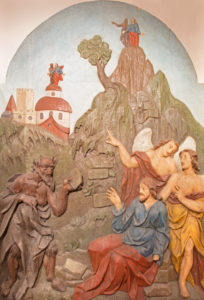 Why was Jesus tempted? The Catechism (##538-540) teaches us that Jesus underwent temptation for us, to show us that we are not alone in our struggle to follow God’s will in our lives, and to show us that we can be victorious in the face of temptation. While the devil tempted Jesus through the allurements of pleasure, power, and honor, the basis for this temptation was Jesus’s sonship. Twice in Luke’s account of the temptation of Jesus the devil premises his temptations with “if you are the Son of God.” The devil tempted Jesus with a perverted notion of what Jesus’s sonship was while Jesus clung to the truth of his sonship which called for perfect obedience to the Father’s will. In the Garden, Adam and Eve lost sight of what it meant to be children of God, of the obedience that was expected of them and the grace that come as the fruit of obedience. Jesus in his temptation, and ultimately in the Cross, shows us that he is the new Adam whereby he completely and perfectly chooses the Father’s will over his own.